Saturday, 3 July 2010

Number Seven

It has been a fortnight since the last CES visit and, since then, the weather has been on the "warm side". Still, if you can't sleep because of the heat, you might as well get up and go ringing!

"First up" - [3J(F)J "Prune"]

First bird up was a juvenile Dunnock and, on the next round, 2 adult female Blackbirds off the nest and out foraging before 6am. Just the one juvenile Garden Warbler this morning and we noticed a small cyst on the gape of this bird. Not something we see very often.

Juvenile Garden Warbler
The first of two juvenile (male) Blackcaps.

Things were looking good. Three early morning Blue Tits turned out to be from very different sites; one to the east, one to the south and the other from a natural hole or a bat box. Two hours in and it was time for a spot of breakfast and pill taking. Munching on a sandwich, I went through a moult sequence with Davy on an adult (6F) Robin.

Adult Robin moulting its primaries, tertials and tail (03/07/10)
Same bird - primary moult score = 12 (3332100000).

Blackcaps were dominannt with 2 juvenile male types (see photo above showing the darker crown colouration), 2 juvenile female types and a new 2CY male. This in fact doubled our juvenile numbers for the year, bringing them level with the adults. It should be noted that one in every nine birds that we catch throughout the broader site is a Blackcap.

A Green Woodpecker tantalised us, but with the bright sunshine that dominated the session, it could see the nets probably better than us!! We caught young Robin number 8 and as yet it has to start its post-juvenile moult.
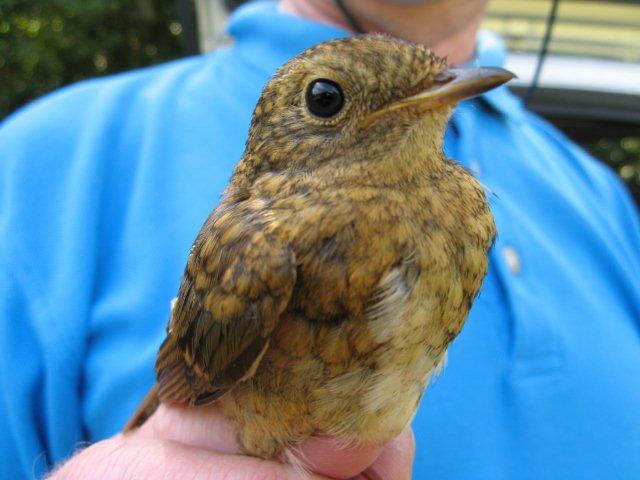
Spotty, juvenile Robin.

Also in the bag were three adult Dunnocks. The first was a juvenile female last year, the second was one of our oldest birds, a male that was ringed as a juvenile in earlyAugust 2004 and the last was a bird caught in May 2007 as a 2CY male. Unfortunately, this year it has developed "bumble foot", similar to Sedge Warblers and Chaffinches. The ring is now tight on the leg but doesnt seem to be restricting circulation to the foot.


The final tally was 20 new and 9 re-traps. Every thing stopped at 10am and no more birds were caught in the fourth quarter of "our alloted time slot". C'est la vie!
Blue Tit 1 (2)
Great Tit 1
Chiffchaff 2 (1)
Blackcap 5
Garden Warbler 1
Whitethroat 2
Reed Warbler (1)
Wren 1 (1)
Blackbird 3 (1)
Robin 2
Dunnock 1 (3)
Chaffinch 1.

Additional highlights of the morning were a passing Sandwich Tern and two Little Egberts over. DK went to photograph the second "whitey" but all we heard after a shutter whirring were some mild expletives - as he had left his 2Gig card in the computer!

Instead - here's one I nicked off Phil Slade

Also spotted the first Common Gull of the autumn whilst looking up at a Sparrowhawk in with a party of 50+ Swifts. Soon after, we picked up a "Buzzorant" while scanning with binoculars, an extremely high Cormorant drifting eastwards, invisible to the naked eye, and pondered on where it had come from and where it would end up.

Sunday, 20 June 2010

Lots of productivity

We thought it would be a dream day for ringing. 7-eighths cloud plus a gentle, subsiding wind, it looked as if it might get better. Dream on. It was COLD! During the first half of our Constant Effort session we, Ed and I, caught eight (8) new birds, and no retraps, of seven species. Put another way, that's one every net round, just about. Mind you, one of them was a full adult male with a stonking brood patch - and his tongue hanging out! Ed had done the last one and I normally give them away to trainees - but today there weren't any, so I had it for myself!
Today's adult male Green Woodpecker (D Kramer)

As the cloud cover increased, it warmed up a fraction. On the minus side, the north west wind picked up a shade, too. "Blow me down", at half-eight, the tit flock passed over and we ended up with ten (10) birds in the nets; the six tits, three with 'nest box rings', also pulled in four more warblers. Well, we thought that was it, a fluke, and over for the day. Perhaps another six might see us to the end of the session, finishing a bit below par for the site and time of year.

Not to be, thank God. We ended up with a grand total of 35; 26 of them were new and 27 of them were birds of the year (four already ringed). So it ended with a list like this:
Green Woodpecker 1
Blue Tit 3 (1)
Great Tit 1 (3)
Chiffchaff 4 - all youngsters
Blackcap 4 - inc a new adult pair
Garden Warbler 1 (1) - the retrap male was ringed as a 4M in May 2008
Whitethroat 3 (1) - our first 3J's of the year & 2 of them had started PJ moult
Our first young Common Whitethroat of 2010

Wren 2 (2)
Blackbird 2 - 3JM & 3JF of the 'longer-winged' variety
[we seem to have 2 sub-populations; with short wings and long wings]
Robin 2 - a couple of spotty juvs caught simultaneously
Dunnock 3 (1) - new youngsters and an old favourite lady from 2007 who was in egg again.

Just to finish off: record shots of the net rides after this week's grass cut and the sides trimming up

Nets 2 & 1 (run N/S) - now disappears into "ash woodland"

Nets 3 & 4 (run E/W) - 'downhill' towards Fingers Lake

40' extra net run - useless until autumn passage; also used as 1 of 2 winter feeding sites.

Thursday, 17 June 2010

Colour ringing

For an inclusive article on what colour-ringing is all about, read Mark Grantham's article on Bird Guides. [Or paste this link into your browser - http://www.birdguides.com/webzine/article.asp?a=2133]

Sunday, 13 June 2010

Sandy Smith Nature Reserve

No Grasshopper Warblers this time despite making a specific evening visit yesterday for this species. We did catch:

Sedge Warbler 4 (all new) - 3 male, 1 female (all adults)
Whitethroat 5 (2 retrap and 3 new) - 2 male, 3 female (all adults) with 2 in egg.


Above: A sedge warbler.

For more photographs and what else we saw/heard this visit, see my blog: http://greenwoodringer.blogspot.com/

Another CES

SATURDAY 12th JUNE: The day dawned with a light cloud covering and a gentle wind - ideal day for ringing. Ed and I had two trainees with us today and they were greeted by some good old 'bread and butter' birds.
Although not vast numbers of birds were trapped in our line of nets through mixed scrub, we ended up with 14 species, ten of which yielded juveniles.

In no particular order the youngsters were - a Garden Warbler, 2 Blackcap, a Chiff, a Long-tailed Tit, 2 Dunnocks, a Robin, a Greenfinch, a Chaffinch, a Blue Tit and 4 Great Tits. These are fairly representative of what breeds in our little one acre patch, situated as it is in a busy country park. Only young Whitethroat was missing, although we know that there are some 1J's about (just out the nest).

The highlight of the day was a Red Kite over the top of us at 08:30, half way through the session. DK took a rather good photo of it and we may be able to add it later.
DK's shot of today's Red Kite - wing tags indicate it was taken to W. Yorkshire in 2000 as a chick from the Chilterns programme - or hatched there [Right pink, Left orange]
Meanwhile ...
A different sort of 'kite' soon after - from the local airstrip

The full total was 17 new and 11 re-traps:
"Whoops. Dead end!" Juvenile Blue Tit.
Blue Tit (1)
Gt. Tit 1 (3)
Juvenile Long-tailed Tit. Note reddish-purple eye ring
Long-tailed Tit 1
Chiffchaff 1
Blackcap 2
Garden Warbler 3 (1)
Whitethroat 1
Male Reed Warbler - 2nd calendar year. Note dull eye colour.
Reed Warbler 2
Blackbird 1
Robin 1 (1)
Juvenile Dunnock showing 'orange' gape flanges
Dunnock 2 (2)
Chaffinch 1
Greenfinch 1
Bullfinch (2)
Male Bullfinch in 2nd calendar year (re-trap)

The oldest birds today were a male Dunnock ringed as a 3 (1st yr) in August 2006 and a male Garden Warbler ringed as an adult in May 2008. The juvenile Blue Tit was ringed in a box elsewhere in the park , whereas the Great Tits all came from a nearby box.

Sunday, 6 June 2010

Hopping through the grass

Hopping through the wet grass, I put up a net at Sandy Smith Nature Reserve and caught 7 new birds. 1 dunnock, 5 whitethroat (see photograph below)...


... and one Grasshopper Warbler.


More photographs on http://greenwoodringer.blogspot.com

Saturday, 5 June 2010

Quick 'n easy

Today, Ed and I set up at the "crescent" reed-bed; that is, on two sides, not through the middle.


Above: The 'ringing station'.

Not a bad morning 'cos we were all done by 9 o'clock.

20 birds in 3 hours is, for us, a good result. As 12 of the birds were Reed Warblers (see photograph below), extraction was "a piece of cake".


Many of the female reed warblers were showing signs of being in egg. Going by this evidence, it will be a short while yet before we catch the first fledgeling Reed Warblers.

Other birds around were -
Mr & Mrs Swan (she's "orange 500") and their 6 cygnets (that we'll deal with when they're a bit bigger),

a Kingfisher over the net here and a Turtle Dove purring away in this willow alongside the net,

and a very vocal Reed Bunting that eventually got fed up singing to itself and took the wrong turning for breakfast/elevenses.

In all, we caught just 8 new birds and a dozen re-traps, of which 2 were 'new-for-year'.
Chiffchaff 1 - a 2CY female nesting nearby
Blackcap (1) - a male caught as a juvenile in June 2008
Reed Warbler (today's target) 5 (7) - oldest was a 2006 bird
Wren 1 - a new 2CY female
Dunnock 1 (2)
Chaffinch (1) - a 2CY male
Reed Bunting (1) - the 2CY male.


Above & Below: These photographs show the same male blackcap.

A brood patch is where adults loose their 'belly' feathers and blood vessels engorge and come to the surface of the skin to enable heat transfer from the adults to eggs & young.

In the photograph below, the male blackcap is shown with a false brood patch. Sometimes, males are known to help with the 'sitting on the nest' duties. In other species where male and female are hard to tell apart, the false brood patch of a male can easily be mistaken for the brood patch of a female (such as the Garden Warbler). This was an easy one though!


In the immediate area, birds that we saw making use of the main lake-side airspace included Greylag (uncommon here), Common Tern (starting to fish more earnestly; family duties?), Swift (much fewer than last week-end), Cuckoo, Gt. Spotted Woodpecker, Common Whitethroat, a party of Long-tailed Bushtits (working their way over the nesting Reed Warblers) and a pair of Goldfinch.