Sunday, 26 September 2010

Ever hopeful

Ed and I went out ringing this morning, despite a stiff northerly wind and grey skies. The breeze had got up quite a bit since yesterday, which was also beautiful and sunny. Still, you never know. The "Rough" is well sheltered from northerly winds so it might work out, nevertheless.

And so it did. The main run of 160' did catch the wind, but not until it had delivered a pair of Blackcaps in the early morning gloom, then a retrap 1CY Marsh Tit and a Blackbird. Despite the wind, a Chiffchaff 'came to tape'.

Today's target species - Blackcap (1cy male)

Ed got the feeding station net up and, to begin with, all we had were re-trap Blue and Great Tits. As it was in the lee of 'the Long Hedge', I moved the lure over there with a modicum of success. Hey Ho, apart from lots more new Blue and Great Tits, two Goldcrests, a solitary Blackcap and five more Chiffs!

The two extremes of Chiffies this morning - adult male & late brood female (juv doing PJ)

Other birds we noticed were a couple of migrating Jays (scarce birds round here, you know), a few Swallows and 110 Starlings beetling south-west, once upon a time a common bird hereabouts. Of course, the local "Bushtit" flock was moving around, 'around' being the operative word since we could see them and hear them - but not catch them!

We took down after four hours and beat a hasty retreat home before the forecast rain caught us out. We had caught 42 birds of which 27 were new and 15 were recaptures. This time the re-trap tits produced four more youngsters from our various boxes situated around the park.
Goldcrest 2
Blue Tit 8 (8)
Great Tit 5 (3)
Marsh Tit (1) - that same youngster
Chiffchaff 6
Blackcap 3
Blackbird 1 (1)
Dunnock (2)
Chaffinch 2

Promise of things to come - Goldcrest (young male)

Another good day; probably worthwhile trying again in the week. Weds? The feeders will need filling in couple of days, anyhow.
Today's pics by DK.

Chalton - summer results

Below is the final count from the Constant Effort Survey at the sewage treatment works; adults first, followed by birds of the year. This is the number of individual birds (new or re-traps from other years) and makes no account of their subsequent re-capture during this year's fieldwork. The works are situated adjacent to the M1 motorway, close to Toddington service station.
Moorhen 1 + 0
Wood Pigeon 0 + 2
Kingfisher 1 + 1
Barn Swallow 4 + 0
Wren 5 + 10
Dunnock 6 + 4
Robin 4 + 7
Blackbird 6 + 1
Song Thrush 1 + 0
Sedge Warbler 20 + 13
Reed Warbler 29 + 28
C.Whitethroat 13 + 12
Garden Warbler 1 + 1
Blackcap 8 + 9
Chiffchaff 4 + 29
Willow Warbler 0 + 1
Long-tailed Tit 5 + 20
Blue Tit 6 + 17
Great Tit 2 + 14
C. Crow 1 + 0
Starling 4 + 0
Greenfinch 0 + 2
Bullfinch 1 + 3
Reed Bunting 6 + 1
128 Adults & 170 juveniles [ 2009 = 111 adults & 188 juveniles)

Wednesday, 22 September 2010

Magnificent Seven

Great Spot. - note the dull eye of this juvenile and the emerging red crown feathers, indicating 'male'.

A lonely vigil today, starting at a dewy 7 o'clock and finishing at a (comparative) sweltering 12 noon. My main intention was to catch a few more Blackcaps, which I achieved. It was also a chance to try out - and learn how to use - the new MP3 player and speaker with a bit of tape luring. It is certainly a tad better than my 30-year old tape set-up, but then that is capable of blasting them out of the sky. I had to join the 21st century sometime!

Well, it went very well. An early Reewa and a Chaff followed by a couple of Blaca cheered me up so I set about putting a net by the new feeders. A Goldf, two more Blaca and another Reewa, plus loads of immature Bluti and new Greti kept me busy for a couple of hours, by which time I decided it was the right juncture for a cupp'a.
Just love the black and white uppers of the King Harry's
A recently fledged juvenile Reed Warbler -all three in different fitness to emigrate
One of two male Blackcaps included in the seven new individuals.

From then on, it slowed down but became the more interesting. A young male Grswo dropped in, two Robin, more tits, another Blaca, a Treec, a couple of adult Lotti, another Goldf, two more Blaca, a third Reewa and finally, at half eleven, a Coati.
On measurements, this young Treecreeper should turn out to be a male.
Coal Tit - I claimed this immature bird as a ringing tick for the park.

Now these are rare in the park; one was seen by DK in Feb 2009, but the previous record was one I and another birder saw back in 1995. Bingo.

At the end of the morning, I had bagged 50 birds of which 10 were retraps. Four of the six tits recaptured had been ringed 'at the nest' as pulli, in different plantations. Twelve species at this location is just above par. I didn't manage to catch any of the 3 Chiffs feeding on Ivy blossom, nor the lone Whitethroat that had been seen here up until yesterday. I only saw 2 Blackbirds all morning and heard an alarm call of a Dunnock without seeing one. The Marsh Tit came to the feeder but not the net! A Hobby came over, too. About 6-8 Meadow Pipits passed west-south-west during mid-morning.

The all important ringing list (re-traps in brackets, as usual):
Gt. Spotted Woodpecker 1 - second for the year
Blue Tit 8 (6)
Great Tit 12 (1)
Coal Tit 1 - 'ringing tick' for the park
Long-tailed Bushtit (2) - both lone adults
Blackcap 7 - now 2010 total (89) beats last year's
(2nd highest annual figure in 20 years)

Reed Warbler 3 - makes 37 youngsters for the year
Treecreeper 1 - second for the year
Wren 3
Robin 1 (1)
Chaffinch 1
Goldfinch 2

Blackcap is the most ringed species on the site. At present it accounts for 11.35% of all new birds. Blue Tit is next (10.49%), then Reed Warbler (5.63%), Blackbird (5.48%) & Sand Martin (5.09%).

A typical young Blue Tit, still a bit scruffy as it comes to the end of its post-juvenile moult (mainly body feathers are replaced).
Surprisingly, only one Great Tit was a retrap (ringed as a pullus, too). Not an adult among them.

One other bit of news - DK picked up a Cetti's on call/song (remained hidden - so only brief views) by the STW bridge, our first since winter 06/07.

Sunday, 12 September 2010

Fatty & skinny

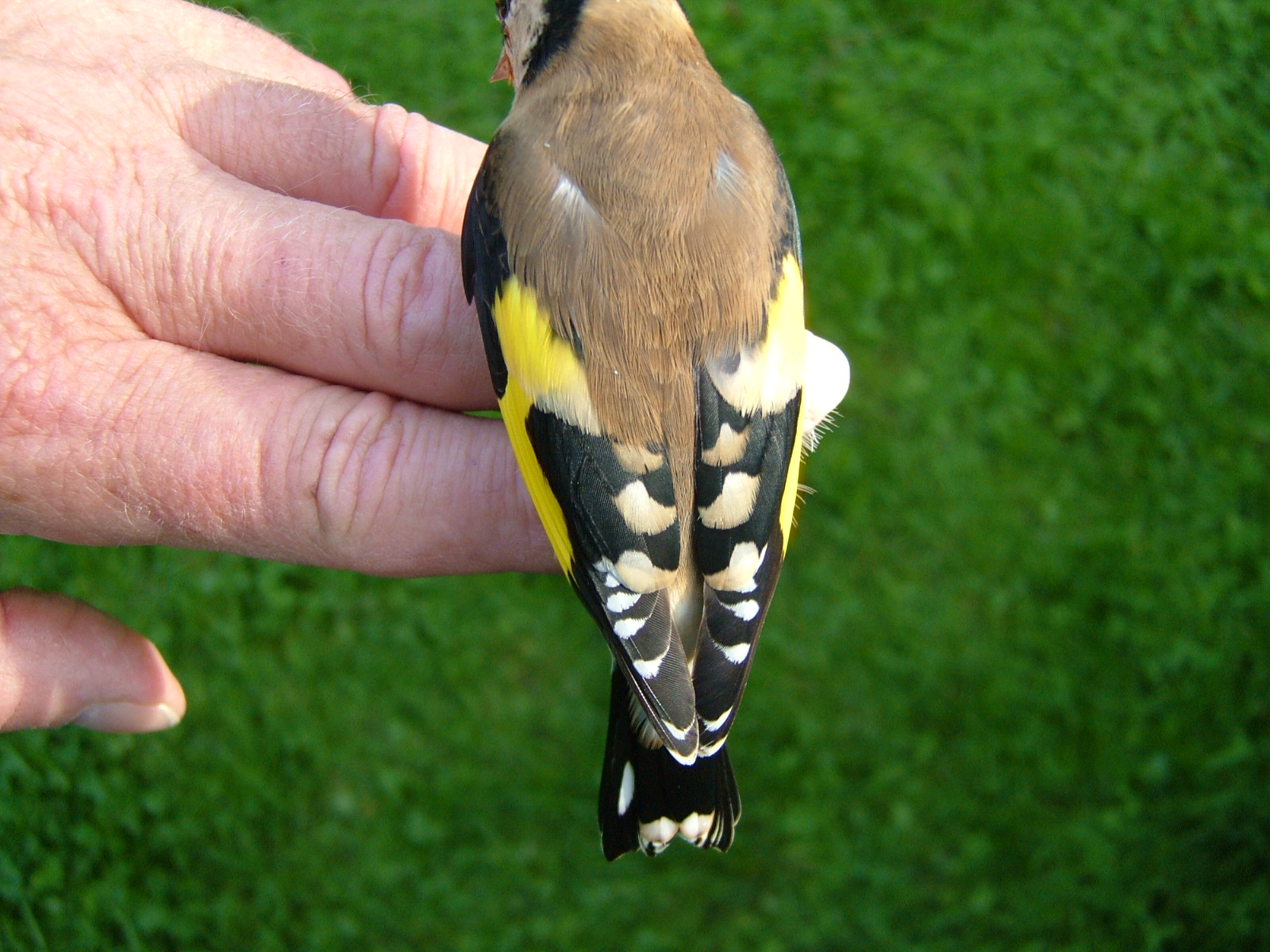
... went out today; that's the Blackcaps, not us!
First up - a 3F Blackcap, fat 4, wt.22.3g
Another session at Priory in the 'rough' from sun-up 'til late morning produced 23 birds, including 6 retraps.
Next up - 3M Blackcap, fat 1.5, wt. 19.2g
Retraps often mean winter is on its way and today we were also delighted to catch 4 tits. These in themselves seem to appear about now, reminding us that we ought really to get the feeders up. Instead, we just cut out the rack through the waist high nettles.

To clarify today's efforts, we have:
Blue Tit 3, still with small signs of their juv plum
One of today's 3F Blue Tits
Great Tit 1,
Blackcap 6 (1), weights from 19.2 - 22.7, except the retrap which we have handled on the last 3 visits without any appreciable weight gain over the 9 days.
Blackbird 1 (2), a couple of adults ending primary moult
Robin 2 (2), all except one were youngsters
Adult male Robin in fresh/winter plumage
Dunnock 1 (1), young males of the year
Greenfinch 1, 3J
Goldfinch 2, both 3J's but only just out of the nest, many primaries in sheath.
Underwing of 1J/3J Goldfinch, showing primary sheaths.
Other birds around included 4 Tufted, 4 c.Swift, 14 House Martin, a C.Buzzard, a Jay and a singleton Spotted Flycatcher.
One man (Ed) and my (new) dog (bitch), Cerise.

PS
. New Blackcaps now only 4 short of last years total for the site.

Friday, 3 September 2010

Black Friday

A short session today, starting ~9am, after the fog started to lift.
Chiffchaff - 2
Blackcap - 12, 10 of these were females!
C.Whitethroat - 1
Wren - 1
Blackbird - 1
Song Thrush - 1, (1)
Robin - 1, (1)
Dunnock - 2
Greenfinch - 1
The only adult birds were two of the female Blackcaps and a male Chiffchaff (with an abietinus call).
Brings the Priory total of new Blackcaps this year to 71. Best year by far was 1994 with 107; next best was last year with 88 and then 2007 with 87. So far so good - at least 4 more weeks to go before passage ceases.

Saturday, 28 August 2010

Hands Solo.

At last, I could get out and ring. Hand almost like new, wellies still performing after 20 years.
Today was a solo effort, since young Ed went off to his new patch at Clophill. Nets went up and the birds came visiting.

Well, they did for about 90 minutes, then an hour long wait for 3 more and, after that flurry, one bird an hour to finish off with. I even put up 2 extra nets (100') but they didn't catch anything. I put it all down to a sudden weather change about 8 o'clock, when the skies cleared, the wind got up and the tops of the nets were bathed in bright sunlight.
"The sky at bright" - taken 8am. (Yes. That is the moon)

It went from bad to worse, too.
The list of 22 new and 3 retrapped birds is as follows:
Chiffchaff 2
Blackcap 6
C.Whitethroat 3
Blackbird 2 (1)
Song Thrush 3 (1)
Robin 1
Dunnock 3 (1)
Chaffinch 1
Goldfinch 1

Overhead there were c.16 Swifts and c.20 House Martins in the early morning sun. Also flying over from the main lake, 15 Shoveler ( spooked by the sailing fraternity), 4 calling Gadwall, & 8 Cormorant but no raptors. Inside the ringing sub-site, there was a Lesser Whitethroat on the top of one of the Elderberry bushes for some while, accompanied by a Garden Warbler at first and then by an unringed male Blackcap. Upwards of 8 Goldfinches blogged to and fro, a young Great Spot flew over, the Long-tailed Tits flew through with a few other hangers-on (tits), across (but outside) the corner of the net run. I heard a Bullfinch, a Greenfinch and noticed 2 Crows in the top of the Pear tree, something I spotted last time I was in here. No sign of the Spot Fly that we watched last Sunday.

Total CES tally this year was 96 adults of 21 species, 169 juveniles of 20 species. We have also captured another 45 individuals on extra visits and ringed 81 tit pulli in the same compartment, a grand total of 360 individual birds of 24 species. Blackcap is still "tops" for the site with 56 caught so far ... and another 6 weeks to go before they all disappear.

Sunday, 15 August 2010

Number 11

Today was the 15th. CES 11 due to be done today. 15th bird today was special. Lesser Whitethroat - our 4th this year. Maybe it was bred here.

A funny old day; no Swifts seen, for a start. A Sparr over the nets just as they were opened set the scene. Another dire first half (like the previous two weekends). Quite a few screaming young Common Terns flying to and fro with their parents.

It turned out to be quite a good day for the Borin Warbler; we managed to get 4 new ones.

The full line up was as follows:
Blue Tit 2 (1)
Gt. Tit (2)
Blackcap 4
Garden Warbler 4
Les. Whitethroat 1
C. Whitethroat 1
Reed Warbler 2
Wren (1)
Blackbird 1 (3)
Robin (1)
Bullfinch 1
... making 24 birds of 11 species, a bit "off the pace" for the time of year.

There was a fly-through Kingfisher (well above the top shelf), a few Swallows, both Gt. Spot and Green Woodpeckers and a Common Sandpiper over the nearby old lake (Fingers) mid-morning.

A little disappointed that we didn't catch more Whitethroats, just this one mid-session.

The weather was 8 oktas decreasing to 7, breezy but moderating, from the NE going NW'ly, light drizzle initially after four damp days and nights. Will we do better next weekend?

And while we're at it, here is a report from Mark Boyd, who did The Thorns today:

"Hi Everyone

You missed a rare opportunity to say that you were at the least productive Waterloo Thorns CES visit ever yesterday. Conditions were fine, a little breezy towards the end of the morning, but nothing exceptional. There were birds around - a bouncing sparrowhawk, a flock of 40 mixed finches, etc - but not many in the nets. All nets were up by 5.30 am. By 07.40 I had caught two birds. I caught the rest at 10.45.
Here are the totals:

Robin 1 (0)
Bullfinch (1)
Treecreeper 1 (1)
Long-tailed tit (2)
Goldcrest (1)

That's right. Just seven birds in total, of which only two were new."

One bit of good news - we had a Blue Tit leave this same CES site near Sandy and travel to Wicken Fen, a distance of 42km. This is our 4th longest distance, the best being 88km for the species.